28 February 2011

2011 NFL Scouting Combine: Running Backs

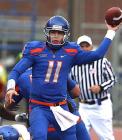
Image: Jordan Todman

The running backs were also on display Sunday (February 27th) at the 2011 NFL Scouting Combine and quite honestly I wasn't very impressed. This 2011 NFL Draft won't be real strong at the running back position.

2009 Heisman Trophy winner Mark Ingram came in a little lighter than his playing weight of 225 pounds. He weighed in at the combine at 5' 9" 215 pounds. The weight loss didn't help him however as he ran a very mediocre 4.62 forty yard dash. Ingram is explosive though, he had an excellent 10 yard split and has never been known as a breakaway threat.

Even though he wasn't the fastest, I think the best running back at the combine was Connecticut's junior running back Jordan Todman (5' 9" 203 lbs). His 40-yard dash time of 4.40 was impressive and he also had a 38" vertical jump and a 10' 6" broad jump. Todman isn't as well known as 2009 Heisman Trophy Winner Mark Ingram, but Todman's 1,695 rushing yards last year was #2 in the nation. He also rushed for 14 touchdowns so he known what to do with the rock.

Oklahoma RB DeMarco Murray also helped himself at the 2011 NFL Scouting Combine. He ran his 40-yard dash in 4.41 seconds, he also recorded a 10' 4" broad jump and 4.18 in the 20 yard shuttle. Murray also had an excellent season on the field last year where he rushed the ball 282 times for 1,214 yards and 15 TDs. Todman and Murray could easily come off the board in the second or third round of the 2011 NFL Draft.

Maryland's Da Rel Scott (5' 11" 211 lbs) actually holds the record as the fastest running back at the 2011 NFL Scouting Combine. He ran his 40-yard dash in a blazing 4.34 seconds. Not super productive at Maryland, but he should get drafted in the middle rounds based off his excellent size speed combination.

27 February 2011

2011 NFL Scouting Combine: The Wide Recievers

Image: Edmund Gates

The receivers worked out on Sunday (27 February 2011) and as expected there were some very fast prospects on the field. Alabam WR Julio Jones pretty much stole the show with a fantastic performance, he will now compete with Georgia WR A.J. Green to be the first receiver selected in the 2011 NFL Draft.

Jones was much faster than anticipated, at 6' 3" 220 pounds he ran his 40-yard dash in 4.39 seconds. His broad jump was off the charts when he almost cleared 12 feet, he lost his balance and tried two more times and ended up with an amazing broad jump of 11' 3". Jones also had a decent time of 6.66 seconds in the 3-cone drill and looked smooth and fluid in the drills. People don't give Jones enough credit for his on the field performance last season (2010), despite battling injuries he recorded 78 catches for 1,133 yards and 7 TDs, including a 10 catch 199 yard, 1 TD performance against eventual national champion Auburn.

Kentucky WR Randall Cobb looked very smooth and fluid in the gauntlet and at 5' 10" 191 pounds, his 40-yard dash time of 4.45 seconds was impressive. Cobb is no workout warrior, he had an excellent 2010 season catching 84 passes for 1,017 yards and 7 TDs. He also ran the ball as a running back and wild-cat QB and rushed the ball 55 times for 446 yards and another 5 TDs.

The fastest receiver at the combine this year was Abeline Christian (Division II) Edmund Gates, who ran his 40-yard dash in 4.37 seconds. Gates had a very productive season on the field where he caught 66 passes for 1,182 yards and 13 TDs. Gates also performed excellent in the other drills, he recorded a 40" vertical jump, and a 10' 11" broad jump. He also possesses decent size at 6' 0" 192 pounds.

Speaking of late first round grades, Maryland WR Torrey Smith looked absolutely fantastic at the combine. His 40-yard dash time initially came in at 4.37 but was later downgraded to 4.43, which is still impressive. Not just a speed guy though, he has superb hands and caught everything thrown his way during the gauntlet drill. Smith weighed in at 6' 1" 204 pounds and also performed well in the vertical jump and broad jump where he recorded 41" and 10' 6" respectively. Only a junior, but Smith still had an excellent year in 2010 where he caught 67 passes for 1,055 yards and 12 TDs.

Division III Mount Union WR Cecil Shorts is an interesting prospect. He measured in at 6' 0" 205 pounds and looked very smooth and quick in the drills. He recorded a decent 6.50 seconds in the 3-cone drill. Shorts is a pretty versatile prospect playing some QB and receiver at Mount Union, he did catch 70 passes in 2010 for 1,196 yards and 18 TDs. Shorts might end up as the 2nd small school prospect drafted after Villanova's gifted offensive tackle Ben Ijalana, who carries a late first round grade.

WR Terrance Tolliver was highly rated entering the 2010 season but didn't catch the ball particularly well. Tolliver will still get drafted however due to his size and speed, he measured in at 6' 4" 212 pounds and ran his 40-yard dash in 4.52 seconds. He looked quick in the 3-cone drill where he ranked 3rd best among receivers with a time of 6.48 seconds. Tolliver also had an excellent time in the 20 yard shuttle when he ran it in 4.03 seconds.

WR Leonard Hankerson (6' 2" 209 lbs) continued his rise up the draft boards, after an excellent performance at the Senior Bowl, Hankerson ran a nice 4.43 second forty yard dash, that's pretty good for a tall receiver. Hankerson also quietly had an excellent season last year for the Miami Hurricaines. In 2010 he caught 72 passes for 1,156 yards and 13 TDs.

SMU WR Aldrick Robinson is a speed demon, he had an excellent combine recording a 4.43 second forty yard dash, 40" vertical jump, 10' 6" broad jump and an impressive 6.65 seconds in the 3-cone drill. In 2010 Robinson showed everyone he is not just a track guy either, he recorded 65 catches for 1,301 yards and 14 TDs.

Some other notable performances were WR Jonathan Baldwin who recorded a 42" vertical jump and 10' 9" broad jump. WR Austin Pettis also had some decent numbers, he recorded the fastest time among recievers n the 3-cone drill with a time of 3.88 seconds.

Check back tomorrow and I'll cover the running backs.

Robert Bryant

26 February 2011

2011 NFL Scouting Combine: Tight Ends

The tight ends were on display today at the 2011 NFL Scouting Combine and we didn't have any Vernon Davis like performances. If you remember during the 2006 Combine, Davis, measuring at 6' 3" 254 pounds ran a 4.38 forty yard dash. He ended up being drafted in the first round (6th overall) and signed a 5-year 23 million dollar deal with the San Francisco 49ers. He hasn't exactly set the world on fire in the NFL, but that's a story for a different day.

The fastest tight end today was also one of the lightest, Rob Housler from Florida Atlantic is only 248 pounds, but at 6' 5" tall he has the frame to put on a few pounds. Housler ran his 40-yard dash in 4.55 seconds. He (Housler) was also the 4th best in the 3-cone with a time of 6.90 seconds and 3rd best in the vertical jump with a jump of 37 inches. The other workout warrior of the day was Nevada's Virgil Green, Green weighed in at 6' 3" 249 pounds and ran his 40-yard dash in 4.64 seconds. Green's vertical jump and broad jump were off the charts at 42 inches and 10' 10" respectively.

Wisconsin's Lance Kendricks was the top rated tight end at the combine, he could be a 2nd round draft pick in the 2011 NFL Draft. He (Kendricks) looked very smooth running his routes and catching the ball and had some decent numbers. Kendrick's 20-yard shuttle run was 3rd best among tight ends at 4.15 seconds, and his 40-yard dash time of 4.75 seconds was decent. Kendrick's broad jump measured an impressive 10' 2", which was 2nd best among tight ends. Kendrick is about the same size as the other two tight ends mentioned previously (6' 3" 243 lbs), but he looked much more athletic and fluid.

The other tight end that really stood out to me was USC's Jordan Cameron, he has very quick feet for a kid 6' 5" 254 pounds and recorded the best 3-cone time of 6.82 seconds. Cameron isn't much of a blocker, but his size/speed combination should get him drafted late. He ran his 40-yard dash in 4.59 seconds and his vertical jump was an impressive 37.5, which were second best among tight ends. His (Cameron) 20 yard shuttle was actually the best among tight ends at 4.03 seconds. Another top rated tight end that looked good at the combine was Arkansas's D.J. Williams. He is a very good route runner and has great hands. He (Williams) is about the same size as the first three mentioned (6' 2" 245 lbs) and his 40-yard dash of 4.67 seconds was decent.

The top rated tight end Notre Dame's Kyle Rudolph didn't work out as he is still recovering from a torn hamstring. Rudolph is one of the few complete tight ends in the draft at 6' 6 265 pounds.

"I'm about 75 to 85 percent but I feel great and I expect to do everything on my pro day, Rudolph said Friday.

Notre Dame's pro day will be held 7 April 2011. With a strong workout, Rudolph might make a late push into the first round of the 2011 NFL Draft. I will be covering the entire NFL Scouting Combine all this week so check back often.

2011 NFL Scouting Combine: Offensive Line

The tight ends and and offensive linemen were on the field Saturday (26 February 2011) going through various drills, getting measured, jumping and running.

Offensive Linemen: OT Nate Solder looks the part, tall at 6' 8" 319 pounds, he plays high and needs to do a better job anchoring against the bull rush, but the former tight end has excellent feet and power. Solder ran the 40 yard dash in 5.05 seconds, recorded a 32 inch vertical jump, 9' 2" in the broad jump and 7.44 seconds in the 3-cone. His best event however was his time of 4.34 seconds in the 20 yard shuttle which was the second best time among offensive lineman.

Boston College OT Anthony Castonzo weighed in at 6' 7" 311 pounds and looked to be in great shape, he looked good in drills and excelled in the 3-cone and 20 yard shuttle. He had the second best 3-cone at 7.25 and the 3rd best 20 yard shuttle at 4.40. Neither have particularly long arms Castonzo (34.5) or Solder (35.5) for their height and neither did well in the bench press. Solder only completed 21 reps. Both tackles however will be top 20 selections in the 2011 NFL Draft, both players are tall and will be projects, and they will both need to play with a lower pad level, get stronger and bend their knees better to be top notch NFL stars.

Three more offensive lineman stood out to me at the 2011 NFL Scouting Combine, two are household names and one unknown. Wisconsin offensive tackle Gabe Carimi weighed in at 6' 7" 314 pounds and displayed excellent power in the bench press, vertical jump and broad jump. Carimi ran a 5.27 in the forty, 29 reps in the bench press and had the 5th best broad jump at 9' 1". USC offensive tackle Tyron Smith is a former tight end, he weighed in at 6' 5" 307 pounds, has huge 11 inch hands and a long wingspan with 36 3/8" arms. Smith completed an impressive 29 reps in the bench, but didn't run due to some swelling in his knee. Smith will reportedly do a complete workout during USCs pro day on March 30th 2011. The workout warrior from the offensive linemen at the 2011 Scouting Combine was Syracuse Center Ryan Bartholomew. He is a little Small at 6' 1" 302 pounds, but he had the best performance in the bench press (34) and second best in the 40 yard dash (4.97). Bartholomew also looked quick in the 20 yard shuttle with a time of 4.62 seconds.

Check back later, I'll be posting updates throughout the 2011 NFL Scouting Combine.

Robert Bryant
www.nfldraftdog.com
www.facebook.com/nfldraftdog

12 February 2011

To Critique an NFL Mock Draft

Its not every day I publicly critique an NFL Mock Draft, but a young man named Jack Mitchell just started a new NFL Draft Website called The Mitchell Draft Company and he asked me to check out his 2011 NFL Mock Draft.

I like the layout of his website and his mock draft looked pretty solid. A lot of Draftniks have recently raised Texas A&M linebacker Von Miller and Jack has him all the way up to the number three slot to the Bills. Miller did look spectacular at he Senior Bowl, but number three seems a little high for him and the Bills desperately need help at receiver and A.J. Green is still available. I checked KFFL and the two starting receivers are Donald Jones and Steve Johnson. I don't know about you but I don't think defensive coordinators stay up at night worrying about those two guys.

At number 11 he has Colorado cornerback Jimmy Smith going to the Texans, and yes the Texans do need help at corner, but I have Smith rated as a late second or third round selection in the 2011 NFL Draft. I even have Miami cornerback Brandon Harris rated higher than Smith.

At 31 he has the Steelers drafting Baylor nose-tackle Phil Taylor, I love this pick for the Steelers, Taylor is a 6' 4" 335 pound beast and the Steelers' current starting nose-tackle Casey Hampton is getting long in the tooth.

Lastly, Mr. Mitchell has the Superbowl Champion Packers taking Iowa defensive lineman Christian Ballard. I love Ballard, I am a Hawkeye and NFL Draft Dog was the first media outlet promoting Ballard, I had him as a first rounder on my pre-season 2011 NFL Mock Draft. I actually know his mom and I wish the best for him, but I wonder if maybe he isn't being over hyped a little since he recently showed up in Mel Kipers' 2011 Mock NFL Draft?

So in closing, welcome fellow Draftnik Jack Mitchell, nice website and NL Mock Draft and keep up the good work.

09 February 2011

Top Small School Quarterbacks for the NFL Draft

This April’s upcoming NFL Draft is one deprived of top tier talent at the quarterback position. The skill level is thin at both the top part and in the later rounds, where only a handful of prospects are graded as legitimate NFL-type passers.

Due to the lack of overall talent, a number of quarterbacks from smaller schools could find their name called in this years' NFL Draft.

Here is a list of the top 5 passers from small schools projected to be drafted.

1.Colin Kaepernick 6-5, 226 Nevada
He is far from a finishing product with a plethora of mechanical problems to correct before he could develop as a passer, but his talent is tantalizing. He has breathtaking speed and has been clocked in the low 4.4s in the forty.

Has average arm strength, can get adequate zip on out routes but can’t fit the football into tight spots as well as some of the elite passer in this class. He also must improve his delivery and must get rid of the ball more quickly. He has trouble checking off primary targets and is erratic on the short dump off passes. On the plus side, he throws a very catchable ball.

His strength is in his mobility, not only he is fast, but elusive in the pocket and in the open field.

He needs to bulk up and of course and to get more experience as a passer, but the Nevada native should be one of the most sough out prospects in the NFL Draft after the second round.

2.Pat Devlin 6-4 221 Delaware
No, he is no Joe Flacco, another Delaware great passer who is now leading the Baltimore Ravens offense, but he is a close as a prospect.

He possesses one of the strongest arms in the draft. Can make any NFL throw. Is accurate in the short-to-intermitted areas of the field but ball tend to miss too many open receivers beyond the 15 yard range.

Is quick than fast and can throw on the run but is not a great overall athlete or running threat.

Needs more polish and game experience, but Devlin is a sound prospect with good upside. He should not last past the third round.

3.Andy Dalton 6-2 211 TCU
A great career and an amazing Rose Bowl performance has elevated Dalton from a borderline prospect to possibly going as high as the fourth round.

Yes, he has accuracy issues, especially in long passes. He locks in too often on primary receivers and misses others wide open, but his intangibles are off the charts.

He is a poised pocket passer with a quick release, good timing and accuracy in the short area. He shows quickness in the pocket and can create outside the hash marks.

Dalton is a true leader who has the ability to become a good game manager but he lacks physical tools and great arm strength. He will would probably scare some NFL scouts come draft day.

4.Nathan Enderle 6-5 243 Idaho
Is big, tall and strong. Has the arm to make every NFL throw and have shown good zip on all passes. Played in a pro-style offense for the Vandals, which should help him at the next level.

Throws one of the most catchable deep ball of any quarterback prospect in this draft.

He is slow (5.05), isn’t a threat to run. His decision-making is sloppy and is inconsistent in his throwing motion. He needs to improve his readings and the speed of his release.

Enderle have some great natural skills but would need at least a few years of seasoning before he can even attempt to managed an NFL game.

Far too raw for selection prior to the fifth round.

5.Jeff Van Camp 6-5 210 Florida Atlantic
Big, strong and with some mobility, the 2010 Owls passer have a very intriguing make up which should gathered some recognition by pro scouts.

Despite great size, Van Camp does not posses a powerful arm. Locks too often on primary target. Struggle to read coverages at times and tends to scramble too early in a play before looking for his secondary option. Doesn’t display leadership skills.

Overall, Van Camp has good physical make up, but his inconsistency and sometimes erratic passing makes him a borderline prospect.

08 February 2011

2012 NFL Mock Draft

Every year about this time I start my mock draft for the following year, all the underclassmen have already declared so we already know most of the top talent that will be available.

Yes it's early, we haven't even had the 2011 NFL Draft, but doing the research to put together a 2012 NFL Mock Draft gives Draftniks like myself a chance to identify the top college football talent very early, plus it's fun.

The 2011 NFL Draft looks like the year of the defensive linemen with probably 3 being taken with the first five picks. Nick Fairley, Da' Quan Bowers and Marcell Dareus all should be gone within the first five picks.

Its early still, but The 2012 NFL Draft might end up being known as the year of the wide receiver. We normally see 3 or 4 receivers taken in the first round, but if most of these talented juniors declare early, the 2012 NFL Draft might have 5 or 6 players selected in the first round.

Here is a quick snapshot of 7 receiver with first round potential for the 2012 NFL Draft:

1. Justin Blackmon, Oklahoma State
2. Ashlon Jeffrey, South Carolina
3. Rueben Randle, LSU
4. Ryan Broyles, Oklahoma
5. Mohamed Sanu, Rutgers
6. Michael Floyd, Notre Dame
7. DeVier Posey, Ohio State

05 February 2011

LSU marching with the Zach 'attack'


Zach Mettenberger is in a great position to unseat Jordan Jefferson as the LSU Tigers starting QB this spring and eventually lead the supremely talented Tigers to its first national title since 2007.

If that was to be the case, Mettenberger would have completed an incredible turnaround that saw him being kicked out of Georgia last April while serving as a redshirt freshman signal caller for violating team rules.

At the time of his dismissal, Mettenberger has just upended current starter and highly regarded Aaron Murray for the Bulldogs’ quarterback job.

Physical speaking, the 6-foot-5, 245 pound Mettenberger is an impressive athlete. He has cannon for an arm and is surprisingly nimble for his size which helps him elude the rush in his only year as started in the JUCO ranks.

Despite throwing 299 footballs for the Grizzlies of the Butler Community College in Kansas, Mettenberger was sacked only 32 times (for a net loss of 220 yards).

The sack total would have been much higher if not at least eight amazing showings of athleticism in several games during the year.

Overall, the product of El Dorado, KS. passed for 2,678 yards (176-299) for a 58.1 completition percentages, 32 TDs and 4 interceptions, accumulating a 166.74 passing efficiency rating in 13 games played, including a 6 TD, 382-yards effort against the Hutchinson Blue Dragons.

His team went undefeated until they met Navarro Community College (TX) in the Citizen’s Bank Bowl, which the Grizzlies lost 13-12.

Mettenberger went 17-28 for 168 yards and one score against one of the stingiest defenses in the JUCO ranks last fall.

That loss aside, Mettenberger demonstrated during his sole season in Junior College why he was highly recruited out of high school in 2009.

He showed go zip on deeps out and a strong command of the middle of the field beyond the 15 yard range. The problem is that his accuracy tends to diminish in close, a surprising development for a young quarterback.

Nearly 45 percent of his incompletion came to TEs running crossing routs less than 15 yards from the line of scrimmage.

Mettenberger needs to work on his slow release that tend to make his passes more deliberate, allowing fast defensive backs, such as the ones he would be facing in the South Eastern Conference, to break and close fast on the football.

He also does not stride in his throws which also limit his accuracy and velocity in the short area allowing defenders better angles at the pass.

Still, his is an overall better prospect than Jefferson because he can provide the Tigers with something they have lacked for three years, a consistent vertical passing attack.

By Raul Colon

02 February 2011

2011 Senior Bowl Review

2011 Senior Bowl

29 January 2011


Christian Ponder started at quarterback for the South, he isn't flashy, doesn't have a canon but gets rid of the ball quickly. Miami WR Leonard Hankerson (6' 3" 205 lbs.) made a nice play on an under thrown ball.


Lee Ziemba played right tackle for the south, he has got great potential. DT Sione Fua (6' 2" 306) from Stanford made excellent penetration on a few plays. North QB Jake Locker had trouble with accuracy, he overthrew his first pass. Locker has some nice potential, but accuracy issues are haunting him right now.


OLB Von Miller made a nice play stopping a screen, he can play OLB in the NFL. Miller was probably the best defensive player in the game, he ran down speedy QB Colen Kaepernick.


The North's Anthony Castonzo played left guard. South Charles Clay, 6' 2" 240 lbs. Tulsa. H- back good blocker, good hands. South WR Leonard Hankerson made a nice TD catch in the first quarter. DE Sam Acho (6' 3 260 lbs) abused Colorado LT Solder for a sack and strip of the football. North DE Jeremy Beal looks very quick and moves well in space. At one point I had him in the first round of my 2011 NFL Mock Draft.


Miami LB Colin McCarthy (6' 2" 240 lbs) is looking good on special teams and at linebacker. McCarthy could be a 3 rd or 4th round steal in the 2011 NFL Draft. Castonzo moved to left tackle and got beat by Arizona's Brooks Reed (6' 3" 262 lbs) for a sack on QB Ricki Stanzi. Arkansas offensive lineman DeMarcus Love gets beat badly around the end by DE Ryan Kerrigan on one play, then gets knocked on his butt on the next, he didn't help himself.


North QB Colen Kaepernick threw a couple good balls on the run. North WR Titus Young was very quick in and out of his breaks. RB Da' Rel Scott, (5' 11" 205 lbs) Maryland, made a nice 32 yard catch and run. Mississipi State DT Pernell McPhee (6" 4" 287 lbs) showed nice hustle and stripped Locker from behind.


DB Kendrick Burney made a lot of plays and looks like a special teams demon. North QB Ricky Stanzi made a couple nice throws in the 4th quarter, he displayed leadership in the huddle and has excellent pocket awareness. Stanzi however, didn't play well in the practices leading up to the Senior Bowl. Baylor DT Phil Taylor is a massive (6' 4" 330) pound nose tackle, he consistently got a great push up the middle. If he (Taylor) keeps his weight under 320 he could be special in the NFL. South WR Jeremy Kerley (TCU) ran a nice route and caught a pass from QB Christian Ponder to put the game out of reach as the South went ahead 24-10. QB Christian Ponder was named the games MVP.

24 December 2010

Georgia Tech's top prospects on display at Indy Bowl


When the Georgia Tech Yellow Jackets take the field against the Air Force Academy in the 2010 Independence Bowl on December 27, the team would feature at least three legitimate pro prospects and an array of fringe players who could play on Sundays.

With many scouts watching, it is imperative for Tech’s top NFL prospects playing on Monday to show more than they have demonstrated so far this season in order to improve their draft status.

On offense the scouts would be looking at mainly at running back Anthony Allen, a bruising 6-foot-0, 231 pound power back that lacks top end speed (4.63 in the 40 yard dash) but posses intriguing possibilities.

Allen, who transferred from Louisville, is projected as a late Day Two pick, possible going in the bottom part of the fifth round.

The senior led Georgia Tech in rushing this past season with 1,198 yards on 217 attempts. He average 5.5 ypc while scoring 6 TDs.

He does posses deceptive agility inside the tackle box, showing good balance and the ability to get his shoulder square when running north and south.

On the minus side, but does not offer anything outside. He does have good burst inside but the lack of speed would limit his value as a feature back.

His hands, which have not been regularly tested in Tech’s Flexbone offense (he only caught 3 balls in 2010), are above average. But he needs to work on route running.

Need to show: He will need to show versatile as a pass catcher and improve his outside agility. He would also need to demonstrate more than he has showed as a lead blocker this year. He is willing to block but shows poor technique.

Of course, most of the attention of the public would go to Tech’s highly productive quarterback Joshua Nesbitt.

The 6-foot-1 signal caller is viewed by most NFL scouts as a running back as he lacks the polish passing skills to play the QB position at the next level.

As a RB, Nesbitt have shown deceptive good speed (4.5) and bulk (a solid 217 pound frame) to merit a serious discussion, but overall, he is no more than a curiosity at this point.

Despite being billed as an agile runner with burst, Nesbitt average only 3.6 ypc in 2010.

More problematic for his draft status, he did not display the raw explosiveness out of the corner as he showed in 2009.

He also lacks any experience as a pass catcher and blocker.

His 2010 numbers were that not impressive as a runner either.

He rushed 166 times for only 598 yards. That’s almost 500 yards less than the previous campaign.

On the plus side, he scored 10 times on the ground and had a 71-yard TD score run, which showed that there’s a degree of explosiveness in him.

Need to show: Nesbitt needs to show burst and agility outside the tackle box in order to improve his draft status which right now hovers in the Free Agent region. It would not hurt either to show more power inside the box.

On defense, cornerback Mario Butler could be the star of the unit, but something seems to be missing despite having all the physical tools desired in a top shelf defensive back.

He has the height, 6-foot-1, and although he could add bulk (182 pounds), is well framed for the position.

Butler does not use his size to his advantaged as he is prone to shy away from contact during running plays.

Aside size, his most important trait is his football speed. He is fast in the 40-yard dash (4.49) but he plays faster on the field.

His numbers were never going to be impressive, but he looked like he lost his agility to turn his hips on a dime, something that separated him from many of his peers in 2009.

Need to show: That he is football ready. That his hips can turn like in 2009 and that he would assist on run support.

By Raul Colon

20 December 2010

Terrelle Pryor not yet there


He should have been in the Downtown Athletic Club podium receiving the 2010 Heisman Award as the best player in college football; after all, he was the prohibited preseason favorite to win it.

That honor went to Auburn quarterback Cam Newton who came from the junior college ranks to post one of the most amazing seasons in the history of the game.

The tremendous year, his powerful arm and uncanny ability to run has him, not only in the thick of a national championship but at the top of many draft boards as NFL scouts are salivating about the promise he could offer at the next level.

He has vaulted to the middle part of the first round, even going as high as in the top 10, according to many draft boards.

All those accolades were expected to be received by another “running” quarterback, Terrelle Pryor.

Instead, the Ohio State signal caller is almost an after though while preparing for the Sugar Bowl and a showdown with Arkansas QB Ryan Mallett, another possible top 10 NFL draft pick in April.

After being one of the most sought out prep prospects in years, Buckeyes Head coach Jim Tressel managed to outbid most of the South Eastern Conference big boys and signed the 6-foot-6, 235 pound Pryor who the Ohio media immediately anointed the “Next Vince Young”.

He has never lived to that hype, or even come close to that level!

By no mean that statement signaled that Pryor is a bust. In fact, there’s an argument that he has improved as a passer.

Last year’s Rose Bowl in which he pasted a very good Oregon football team is a testament to what he could be able to do.

The problem is that those games are too few and far between.

The truth is that with his incredible size, incomparable arm strength and amazing speed (clocked in the low 4.40s), he should dominate all games just like Newton did this year.

He was just 12-27 for 233 in a home win against an overwhelmed Miami Hurricane. He did rush for 113, but on 20 carriers. That’s not a dominant performance.

In fact, an argument could be made that ‘Canes QB Jacory Harris outplayed him.

Yes, there were the 4 interceptions, but three of them should have been caught.

In the Buckeyes’ only loss of the year against Wisconsin, Pryor threw for only 153 yards.

Unlike the Miami game, the big QB did not supplement his poor passing with a robust running game finishing up with 56 yards, with most of them coming against the Badgers’ preventive pass defense late in the game.

All of this from an athlete many believed who be able to snatch the Heisman in 2010.

There’s still time for Pryor to reach for more than a secondary role as he is certain to be back next year at Ohio State.

But before he reach his full potential, if he ever does, Pryor needs to develop what Newton has done in a just a season: a consistence mid-to-long range passing game.

He also needs to mature as a leader and to show that he can takeover a game before his once enormous promise is reach.

By Raul Colon

01 December 2010

Teams, BCS bowls getting set


The Bowl Championship Series (BCS) conferences and bowls announced those teams which remain under consideration to participate in the five games that comprise the BCS.

The University of Oregon has become the first automatic qualifier. The Ducks will be at least co-champions of the Pac-10, and own the tie-breaker with the other possible co-champion, Stanford.

Nineteen other teams remain under consideration. The teams were identified during a teleconference among the 11 Football Bowl Subdivision conference commissioners, the Notre Dame athletics director, and representatives from the Discover Orange Bowl, Allstate Sugar Bowl, Tostitos Fiesta Bowl and the Rose Bowl Game presented by VIZIO.

The No. 1 and No. 2 teams in the final BCS standings will meet in the Tostitos BCS National Championship Game January 10 in Glendale, Arizona.

The champions of the Atlantic Coast, Big East, Big Ten, Big 12, Pac-10 and Southeastern Conferences automatically qualify for a BCS game.

In addition, the highest-ranked conference champion from among Conference USA, the Mid-American, Mountain West, Sun Belt and Western Athletic Conferences earns automatic qualification to one of the BCS games if that champion is ranked No. 12 or better in the final BCS standings.

Finally, given the seven automatic qualifiers described above, three at-large berths will be available. The bowls will fill those berths from teams ranked in the top 14 of the final BCS Standings.

No conference may place more than two teams in the BCS games, unless the conference has two teams in the National Championship Game, and neither team is its champion.

The final BCS standings will be compiled Sunday, December 5. The BCS bowl pairings will be announced at 8:15 p.m. Eastern time that day, on ESPN television.

The champions from the six conferences which receive automatic spots in the BCS games have not been determined. The following is a list of teams still contending for their conferences’ championships:

In the ACC, Florida State, Virginia Tech, in the Big East, Connecticut, Pittsburgh, West Virginia, the Big Ten, Michigan State, Ohio State, Wisconsin, the Big 12: Nebraska, Oklahoma, and the SEC, Auburn, South Carolina.

In addition to those teams, the pool of teams remaining under consideration also includes Arkansas, Boise State, LSU, Missouri, Oklahoma State, Stanford, and TCU.

19 November 2010

Willimas earns distinction


D.J. Williams of Arkansas was named John Mackey Tight End of the Week. The Southeastern Conference senior recorded five receptions for 58 yards and tied a career high with two touchdowns as Arkansas routed UTEP, 58-21.

Williams was also honored this week with the 2010 Disney Spirit Award given annually by Disney Sports to college football's most inspirational figure. Honorable mentions considered for this week's Mackey Tight End of the Week include Ladarius Green of Louisiana and Rob Housler of Florida Atlantic. Both were involved in a great Tight End match up against each other in a game that saw both of these players lead their respective teams in receiving yards as Tight Ends...a rare feat.

The 2010 recipient of "The Mackey" will be announced at the Home Depot ESPNU College Football Awards Show December 9, 2010 on ESPN.

Other John Mackey Tight Ends of the week are Virgil Green, Nevada (Week 1),Kyle Rudolph, Notre Dame (2), Lance Kendricks, Wisconsin (3), Lance Kendricks, Wisconsin (4), Collin Franklin, Iowa State (5), Michael Egnew, Missouri (6), Ben Thayer, Eastern Michigan (7), Mike Cruz, Pittsburgh (8), Orson Charles, Georgia (9) and Lucas Reed, New Mexico in Week 10.

By Raul Colon

12 October 2010

Oregon’s Path to the Title

Oregon has moved into the #2 ranking in the nation on the strength of several, lopsided wins against mostly less than stellar competition. The biggest win so far this year was a 51-31 triumph over a very good Stanford Cardinal team.

Fueling the impressive 6-0 record is one of the most explosive offenses in college football. The Ducks are averaging 54.3 points per game (567 total yards) behind an electrifying rushing attack led by RB LaMichael James who has gained 848 on the ground (7.4 yards per attempt) in just five games.

His 169.6 yards per game are tops in the nation and James should be a leading candidate for the Heisman Trophy. Aiding James is dynamic quarterback Darron Thomas, who besides rushing for 221 yards in five starts, has produced a balance air attack (1,213 yards, 147-88 for a 58.5 completition percentage and a 14-5 TD-INT ratio). Something the club lacked last year.

Now comes time to look ahead and a possible Bowl Championship Series title game.

The Duck’s next game will be Oct. 21 versus UCLA, more likely another lopsided victory. Then will come perhaps their biggest obstacle to a national championship when the team travels to the Coliseum for a date with enigmatic USC.

Despite its current 4-2 record, that includes back-to-back losses, the Trojans are one of the most talented teams in nation, and in a one-game-season type of setting, Lane Kiffin’s club could mount a serious challenge to Oregon’s dominance of the PAC-10 and a possible title run.

If they defeat the Men of Troy, then all bets are off as the Ducks will likely blow Washington and Cal out, setting the stage for the final two critical games.

On Nov. 26, the Friday after Thanksgiving, the team will receive the visit of the #17 Arizona Wildcats and then finish up the season with their annual Civil War against #24 Oregon State.

Arizona, although a good, solid team, hasn’t distinguished itself from the pack. Their only signature game was a 34-27 win over Iowa. As a club, Arizona is averring just 116.4 ypg, and that was mainly due to their wins over Toledo and The Citadel, in which RB Nic Grigsby averaged 149 ypg.

In the last two years, the Ducks have ended Oregon State’s Rose Bowl dreams including a 65-38 beat down the last time both clubs met in Corvallis, site of this year’s match up.

The Beavers already have lost to #3 Boise State and #4 TCU, both times they failed to capitalize on mistakes.

Despite possessing one of the most versatile players in the country in RB Jacquizz Rodgers, Oregon State has failed to produce a consistent rushing attack. The team is averaging a pedestrian 115 ypg on the ground, and that simply wouldn’t cut it against the Ducks.

Simply put, the Beavers do not have the ‘horses’ to compete in a shootout with Oregon.

Thus, the path to the BCS title game is clear, win out, against a very average schedule, and this Duck team will be playing for all the marbles on January 10.


By Raul Colon
raul@nfldraftdog.com

19 September 2010

What we have learned….


Week three of the college football season is usually when patterns are starting to develop. With this in mind, here are some of the things we learned this past weekend.

1)Alabama could be as explosive as anyone in the nation: The Crimson Tide racket 626 yards in their 62-13 pasting of Duke. Heisman trophy winner, RB Mark Ingram showed no ill effects from his recent injury rushing for 151 yards, including a 50 yard TD dash.

2)TCU is more than the real deal: While the talk of the non-BCS title contenders teams center on Boise State, the Horned Frogs are quietly setting them self up for a title shot. Their 45-10 romp over a very athletic Baylor team is another sign that they can beat anyone in the nation.

3)Texas is the more beatable top 10 team in the nation: For the past three weeks we have seen poor overall performance by the Longhorns. They have looked sluggish on offense while the defense has been suspect, especially in the secondary.

4)Nebraska is back: The Cornhuskers demonstrated on Saturday that they are the class of what is beginning to look like a diluted Big XII. Nebraska put 56 points on an underrated Washington defense. The big difference for the ‘Huskers this year is that they have a quarterback (redshirt freshman Taylor Martinez) athletic enough to run the new combination of the spread-option the club is employing. It sure seems like old times in Lincoln.

5)West Virginia is a juggernaut: The Mountneers have not only demonstrated that they are the beast of the Big East, but they could sneak into the national championship contention. QB Geno Smith could gather some Heisman votes if he helps West Virginia defeat LSU next Saturday.

6)QB Ryan Mallett and the Razorbacks are ready for Alabama: For two years now, the big Arkansas’ signal caller has been teasing us with the possibility of greatness, now it seems those lofty expectations are being met. Mallett looked like a number one NFL draft pick on Saturday when he shredded Georgia’s secondary for 380 yards and 3 TDs.

7)Wisconsin is not a legitimate top 15 team: For three weeks now, the Badgers have struggled to defeat opponents they were supposed to blow out. Their defense is sound, the problems rest on offense where imagination and explosiveness are not part of the vocabulary.

8)The PAC-10 is more than underrated: This weekend showed how little respect the once perennial conference in the nation is getting. Aside Cal implosion on Thursday, the rest of the league have looked sharp, even beleaguered USC. Oregon looks like a national championship contender blowing people out. Arizona’s big win (34-27) over #9 Iowa is another clear sign the league is much better than advertised. Plus, don’t forget about Stanford which has a player (QB Andrew Luck) that could take over any game.

9)Robinson is saving Rich Rodriguez’s job, for now: QB Denard Robinson (10-14, 241 yards, 2 TDs, 1 INTs, 17 carries for 104 yards, 1 TD) is Michigan football. He is the main reason the Wolverines are 3-0. The defense looks like the same unit that imploded last season. UMass managed 429 yards, including 217 on the ground. That wouldn’t cut it in the rushing-driven Big Ten.

10)Florida’s talent is far superior to anyone, except ‘Bama, in the SEC: Despite another lackluster offensive performance, the Gators easily defeated Tennessee, 31-17, showing in the process that their talent is good enough to compensate for turnovers (4 fumbles, one lost) and penalties (5). But they would need more if Urban Meyer’s club wants to challenge the Crimson Tide for SEC predominance.

By Raul Colon
rcolonfrias@yahoo.com

06 September 2010

Boise State Ready to Shock the World, Again


The Broncos of Boise State have defeated a Top 10 team before, upsetting the more highly regarded Oklahoma Sooners in the 2006 Fiesta Bowl and the TCU Horned Frogs at the same venue two years later, will they do it again this Monday?

It all rest on the shoulder of the defense. Last year Defensive Coordinator Pete Kwiatkoski and the ‘Blue Defense’ dominated the Broncos’ two biggest rivals, as both the Oregon Ducks and TCU managed to put a combine 18 points on one of the most underrated units in the nation.

Nine starters return from a unit that forced 35 turnovers and racked 26 sacks last season. Both ends, Ryan Winterswky and Shea McClellin, are potential All Western Athletic Conference [WAC] candidates. Winterswky is the most active player along the line. Last fall, the 6-4 senior registered 9 unassisted sacks, tops in the Conference.

While the ends will provide outside rush, it is the interior line that would be actually the key Monday night. Look for junior tackle Billy Winn [12.5 tackles for loss, also the best mark in the WAC] and the underrated Chase Baker, to be heavily involve in attacking Virginia Tech’s unorthodox running attack.

Last year North Carolina showed how to stop RB Ryan Williams and company by splitting the gaps in the line and maintaining a constants edge rusher on patrol at each side if the defensive line. The Tar Heels limited the Hokies to just 95 (2.9 ypc) rushing yards. Boise has the same defensive structure and philosophy.

If the Broncos managed to shut down the Hokies’ vaunted ground attack, it will be up to QB Tyrod Taylor to win the game. Despite his vastly improved passing stats [136-243-2,311 with a 13-5 TD/INT ratio], the senior multithread signal caller is still a 56.0 completition percent passer with most of his connections going in front of the secondary, not over the top.

This means that probably most of the passes Taylor managed to connect against Boise will not travel more than 10 to 15 yards, well within the range of one of the fastest linebacker corps in the nation and the best overall secondary V Tech has faced in two years.

The Broncos defensive backfield is lead by Fiesta Bowl Defensive Most Valuable Player [MVP] and All American candidate, CB Brandyn Thompson. The other corner, Jamar Taylor, although only a sophomore, has the ability to cover speedy Jarret Boykin, the Hokies’ best wide out.

Of course, the best bet for the Broncos is for Heisman Trophy candidate, QB Kellen Moore to have one of those career-defining games, such as the one former Nebraska Heisman winner, Eric Crouch had against Oklahoma almost a decade ago.

Moore have the ability to do juts that and more and with All-WAC wide receivers Austin Pettis and Titus Young, tight ends Tommy Gallarda and Kyle Efaw, the Fiesta Bowl Offensive MVP and a plethora of efficient running backs. Boise should not have trouble moving the ball against a stingy but soft secondary.

In 2009, V Tech allowed an average of 167 passing yards a game [47.4 completition percentage], but that was mostly done versus average passing schemes. Sophisticated, pass-first teams such as Duke, which torched the Hokies for 359 yards, give Tech problems.

Keeping Moore straight will be another matter. The Hokies had one of the most active defensives fronts in the Atlantic Coast Conference last year registering 36 sacks, including three games with at least six drops.

But that part of the defense lost five starters, including both ends and one interior lineman. The secondary is vulnerable as it had only one starter back, Rashad Carmichael, who led the team with 6 INTs in 2009. The rest, CB Jayron Hosley, and safeties Davon Morgan and Eddie Whitley lack the experience to cover more than simple pass routes.

Prediction: The game is at Blacksburg, Va., which gives the Hokies an advantage, at least on paper. They are a well rounded team with Williams, who is a special talent that should, despite Boise’s best efforts, eclipse the 100 yard mark. The problem for Tech is that wouldn’t be enough to stop the most explosive offense they have faced in three seasons.

This game is the Broncos’ season. A win over the 10th ranked Hokies will almost assure them a trip to the Bowl Championship Series title game and boost Moore’s Heisman credentials.

Boise by five, 25-19.

13 August 2010

UCLA 'kicking' themself out of the bottom


UCLA maybe a mediocre football team, but there’s nothing average about their kicking unit. Lead by special team coach, Frank Gansz, Jr., the Bruins had developed the most potent kicking team in the nation.

Everything starts with kicker Kai Forbath. The 2009 Lou Groza [Best Kicker] Award Winner and All American selection, is arguable the most consistent kicker of the past 5 years.

In 2009 he connected on 28 out of 31 Field Goal [FG] attempts, an amazing 90.3 accuracy percentage which topped the PAC-10 by a whooping five points. His longest was a 53-yarder. All 3 misses where from distances of 51 yards or more. The 6-foot-0, 207 pound senior also hit 24 out 25 extra point attempts. His only miss was due to a bad snap and placement.

Complementing Forbath is potential All American candidate, punter Jeff Locke. Just a sophomore, the 6-foot-1 Locke is already turning heads with his long drives and accuracy in placing the ball inside the 20 yard line.

More impressive than the twenty kicks he placed there is the fact that he averaged a 4.8 yard gained on each of them. That meant that the opponent started on their own 15.02 yard line every time he placed a punt inside the 20.

His 70 punts [average of 43.6 yards with a net of 38.0], second in the conference, are one of the reasons UCLA posted a 7-6 record last year, including a win over Temple in the EagleBank Bowl, instead of finishing below the .500 mark for the third straight season.

“He [Locke] is that good. His only blocked punt was a deflection. Without him, we could have easily loss two games,” UCLA Head Coach, Rick Neuheisel said. “We are lucky to have the best kicking team in the country. None is better than Kai and Jeff,” he added.

NFL draft evaluators project Forbath, the top kicker prospect entering the season, to be a high mid level selection, possible going as early as the fourth round.

By Raul Colon
rcolon@nfldraftdog.com

10 August 2010

Teams to watch out for in 2010


Every year there are a few teams that are supposed to be on downturn. Programs that are not projected to be more than average in the national scene but thanks to a combination of better-than-average coaching, a workable schedule and a good talent pool, managed to out performed expectations. This year there are three teams that possessed those traits.

Topping the list is perennial powerhouse USC. Banned from the post season because of NCAA sanctions, the Men of Troy will seem to be a program on decline. But this is Southern California which means that they still have one of the deepest talent bases in the country. Add to the mix an energetic head coach and a more than manageable schedule, and it is possible the Trojans could run the table and finish undefeated and near the top of the Bowl Championship Series standings.

The expectations are not that lofty in South Bend. Three years of underachieving has done away with that. Enter Brian Kelly; a motivator with radical offensives concepts and a reputation for quick turnarounds that, coupled with an underrated roster, could make the Irish a formidable foe come November.

Its seem odd to peg the surprising label to a team that had average 10 wins over the last five years, but for all those wins, West Virginia still have underachieved. Picked to play in the BSC title game at least two times in the last four seasons, the Mountneers have falter badly when all the chips were on the line. This has prompted many to dismiss them as realistic national contenders.


1.USC Trojans: This is new territory for the Trojans. Gone are the preseason top 5 rankings, the opportunity to play for the national champion and another PAC-10 title. Without the possibility of playing in the postseason, many predict a repeat of last year mediocre 9-4 record.

This is much better team than that. Sophomore QB Matt Barkley is a year older. He looked very sharp during spring practices. As always, the Trojans are loaded at the running back with the underrated Allen Bradford paving the way. Guard Butch Lewis leads a veteran offensive line.

While the defense lost many key figures such as end Everson Griffen and safety Taylor Mays, the unit is much improved thanks to the return of arguable one of the two best corners [TJ Bryan and Shareece Wright] in the conference. The anchor of the unit should be DT Jurrell Casey who is primed for a big year.

The schedule also helps. None of the Trojans 7 road games are against teams that were ranked in the final poll in 2009. Last year, new Head Coach Lane Kiffin took a less talented team [Tennessee] to a respectable 7-6 mark, including their first bowl appearance in two years. A perfect season is more than achievable.

2.Notre Dame Fighting Irish: New head man Brian Kelly is a master at turning around moribund programs. He put Central Michigan on the football map in just two seasons and did the same with was once a doormat Cincinnati program. In his tenure, the Bearcats went to two BCS games and won 10 games in three straight seasons, something the school last did in 1951, while in the process dominating the underrated Big East. He should be able to work his magic down in South Bend.

There are holes, more importantly at QB where inexperience is abundant. But that is not as worrisome as some may think. In 2008 Kelly used 4 different signal callers and still won the conference. His offense is that imaginative. Plus, keep an eye on Dayne Crist, a highly touted signal caller with a live arm and a good feel for the spread attack Kelly covets so much.

The problem could rest on defense where the lack of size up front could cost at least two games. The team is changing back to a 3-4 alignment where they can mask that deficiency. The linebacker corps should be the heat on the unit thanks to the return of three starters, including top playmaker Brian Smith and budding star Manti Te’o.

If two losses are all but assure, that leaves 10 winnable dates. If we subtract the only other ‘sure’ loss on the schedule, USC, the Irish are looking at a 9 win season.

3.West Virginia Mountneers: Some one needs to win the Big East, why not the most balance team in the league? Yes, Pitt is the trendy pick and with good reason. They have the offensive talent to easily win the conference. But they do not have the balance West Virginia possesses.

Linebackers J.T. Thomas and Pat Lazear are two of the best inside defenders in the league. The line is not the biggest, but it certainly one of the quickest in the nation. The secondary could be formidable if CB Brandon Hogan continues to develop.

RB Noel Devine leads a consistent, albeit, not explosive running attack. The key will be QB Geno Smith who is entering his first full season as a starter.

The schedule is not that daunting with only three possible losses in it. A revamped LSU could prove to be too much to handle on October 9th, as could a date with talented South Florida the following week. And there’s the always entertaining Backyard Brawl against archrival Pitt. Expect West Virginia to win at least 9 games for the third consecutive season, but this time against the much tougher schedule.

By Raul Colon
rcolon@nfldraftdog.com

22 July 2010

Top five College Football Defenses

While offense may dominate highlight reels, it’s the defense that usually separates the contenders from the pretenders. This year is no exception. There are at least ten Bowl Championship Series (BSC) programs with the talent to field high quality defenses. Five of them have the talent to elevate their team to new heights.

1. North Carolina Tar Heels: Head coach Butch Davis certainly knows defense and his 2010 version could be the best in the history of the program. No other school in the nation can boast having five (S Deunta Williams, DE Robert Quinn, DT Marvin Austin and LBs Bruce Carter and Quan Sturdivant) potential first round NFL draft candidates on their roster. But what really separates North Carolina form the pack is depth.

That depth is no more present than on the linebacker corps where every member of the rotation, including the reserves, should play on Sundays. It all starts with Carter, a projected top 10 pick, who is hands down the best outside linebacker in the nation. The 6-foot-3, 230 pounds senior anchors the strong side in Davis’ attacking version of the 3-4. The weak side is manned by another highly regarded prospect, Sturdivant, while the middle is in the equally capable hands of Kevin Reddick. Waiting for the chance to get into the field are two highly regarded players, redshirt freshman William Hyman and sophomore Shane Mularkey.

Few adjectives describe better the Heel’s defensive line than ‘intimidating’. Defensive tackle Austin and DE Quinn are sure fire top 15 picks. Both are superior pass rushers with intimidating run support ability. Juniors Quinton Coples and Tydreke Powell, both of whom projects as a high picks next April, are just as active. Look for talented sophomore Donte Paige-Moss, to be more involve in the rotation.

Williams may command much of the preseason headlines, but the secondary is far more than a just a “one man gang” with senior CB Kendric Burney shutting down the right side. There’s a bit of concern on the left thanks to senior Charles Brown’s inconsistencies.

2. Iowa Hawkeyes: Others teams may have better, overall talent but few play with the consistency of the perpetually underrated Hawkeyes. Norm Parker enters his 12th year as defensive coordinator with arguable the most athletic unit of his regime.

The defensive line should be the backbone of the defense. It all starts at left defensive end where all everything Adrain Clayborn resides. The 6-foot-4, 286 pounder was considered a sure fire, top 10 2011 NFL Draft prospect before he was charge for assaulting a cab driver early in the year. Still, his on-the field talent can not be denied. He is a difference maker; just ask Georgia Tech which got stuffed by the big and agile Clayborn in the Orange Bowl. The rest of the line is solid with DE Broderick Binns, and defensive tackles Karl Klug and Christian Ballard. Ballard, a senior, is a unique player who usually commands two blockers which allows Clayborn and Binns to have more leeway outside.

The secondary is the best in the Big Ten with an All American candidate at strong safety (Tyler Sash), an all conference free safety, (Brett Greenwood), and two speedy corners (Shaun Prater and Micah Hyde).

The weak-link may be the linebackers where inexperience surrounds the unit. MLB Troy Johnson, who performed adequately last season as a backup, needs to do a better job sealing the left side. WLB Jeremiha Hunter is a fast and agile player with the range to cover backs and tight ends, but needs to add toughness to his game. The same goes to strong side linebacker Tyler Nielsen.

3. Oklahoma Sooners: It could come as a surprise to see the Sooners, a team which lost two highly regarded linemen, including the NFL draft’s number three pick, being listed this high, but their talent level is just that good.

The secondary is loaded with potential all conference honorees. Strong safety Sam Proctor had 10 picks in 2009 and looks to be a great fit in centerfield. FS Quinton Carter is a ball hawk playmaker with the speed and agility to cover any wide receiver. The corners are filled with potential, starting with former S Jonathan Nelson. The 5-foot-11 Nelson should be better on the left side than he was in the middle. RCB Demontre Hurts saw plenty of action as a freshman last fall, flashing top tier potential.

Defensive coordinator Brent Venables employs an attacking version of the 3-4 which requires fast moving linebackers, especially on the weak side. Current incumbent, Travis Lewis, fill that bill and then some. The 6-foot-2 junior was Oklahoma’s top tackler last fall often displaying seldom-seen explosiveness for the position. MLB Tom Wort is strong, although he lacks speed. Look for either sophomore Daniel Franklin or junior Austin Box to cut into his playing time sooner rather than later.

The line is in a rebuilding mode. Gone is Gerald McCoy, a force inside. His replacement is highly recruited sophomore Jamarkus McFarland. Adrian Taylor is the other tackle. The strength of the unit resides on the outside with the tandem of All American candidate, Jeremy Beal, and the ultra quick Frank Alexander.

4. Miami Hurricanes: Much had been written about the ‘U’ being back among the ranks of college football elite. At the heart of this perceived comeback lays three straight top 15 recruiting classes, which was heavily tilted towards the defense. Because of this emphasis, the ‘Canes now fields the fastest unit in the ACC.

Speed reigns supreme on the line with ends Allen Bailey, a potential All American, and Andrew Smith. DT Curtis Porter is a budding star as is his backup, fellow sophomore Marcus Forston. The linebacker corps is bound to be better thanks to the return from injury of SLB Colin McCarthy. Keep an eye on junior WSL Ramon Buchanan who last year showed flashes of greatness.

Miami returns their top seven defensive backs from 2009. The corners, led by Brandon Harris, a projected high NFL pick, are solid, if not spectacular while the safeties (Vaughn Telemaque and Jared Campbell) appears to be just as good.

5. Ohio State Buckeyes: Every other year, head coach Jim Tressel and his Buckeyes assemble a strong-enough defense to spur national championship talk in Columbus. Ohio State will try to defend its Big XX title armed with what is probably the second best linebacker corps in America.

Ross Homan, OSU’s top tackler in 2009, patrols the weak side while rising star, Brian Rolle clog the middle. The player to watch could be junior Andrew Sweat. The line does need work in the interior. Neither Dexter Larimore nor John Simon offers anything special there. The highly of the line is end Cameron Heyward who should blossom into a star this season.

Both corners, Devon Torrence and Chimdi Chekwa, have shut down skills while FS Jermale Hines is tough to beat. The star of the group is sophomore strong safety Orhian Johnson who should gather some all-conference honors in his first full season as a starter.

By Raul Colon
rcolon@nfldraftdog.com

19 July 2010

All Sun Belt First Team Offense


The Sun Belt may not gather the headlines others, non-Bowl Championship Series (BSC) conferences, such as the Western Athletic or Mountain West, receive. But it should. The ‘Belt’ is considered the home of the spread offense. No less than seven of its nine members utilized one version or another of this, no famous scheme.

This, among others things, mean that most of the skill position players in the conference are fast, agile and tough to bring down in the open field. Middle Tennessee State quarterback, Dwight Dasher fills that description to the letter. The senior signal caller is one the top returning running QB in the nation and the main reason the Blue Raiders, which knocked off Maryland last fall, are one of the rising programs in the country.

Tailbacks Alfred Morris and Lance Dunbar are tailor made for the spread. Both are small, darting playmakers who love to hit the corners. The wide outs are not that much taller, but they are even more explosive. Keep an eye on Troy’s Jerrel Jernigan. The electrifying wide out ca score every time he touched the ball.

The line, although not as physical as others, is more than capable of holding their own against bigger foes.

Preseason All Sun Belt Conference Offensive First Team


QB Dwight Dasher (5’10”, 201lbs, Sr.) Middle Tennessee State Blue Raiders

RB Alfred Morris (5’11”, 222, Jr.) Florida Atlantic Owls

RB Lance Dunbar (5’9”, 202, Jr.) North Texas Mean Green

WR T.Y. Hilton (5’10”, 174, Jr.) Florida International Golden Panthers

WR Jerrel Jernigan (5’9”, 184, Sr.) Troy Trojans

TE Ladarius Green (6’6”, 225, Jr.) Louisiana Raging Cajuns

OT Esteban Santiago (6’3”, 296, Sr.) North Texas Mean Green

OT Mark Fisher (6’3”, 272, Sr.) Middle Tennessee State Blue Raiders

OG Derek Newton (6’5”, 313, Sr.) Arkansas State Red Wolves

OG Brandon McLeroy (6’3”, 304, Jr.) Middle Tennessee State Blue Raiders

C Tyler Clark (6’2”, 285, Sr.) Troy Trojans

BEST PRO PROSPECT: WR Jerrel Jernigan, Troy

By Raul Colon
rcolon@nfldraftdog.com

18 July 2010

All Conference Team: The Big East


No conference in America offers a mix of offenses schemes like the much mélange Big East can. On one side of the spectrum there is the pass-happy, two-time league champion, the Cincinnati Bearcats. On the other ends reside the run crazed Pitt Panthers.

Between those two, there’s a plethora of highly entertaining and very creative offenses led by some of the most dynamic playmakers in the country.

Despite the fact he is just a sophomore, Tom Savage is the most battle-tested signal caller in the Conference. At 6-foot-5, packing a solid frame (230) and sporting a rocket for an arm, Savage is sure to gather the attention of many NFL scouts this year.

The intriguing Panthers leads the offensive parade with three all conference selections. Running back Dion Lewis is a projective All American, as does wide out Jonathan Baldwin and left tackle Jason Pinkston. All three are viewed as top 50 material for next April’s NFL Draft.

Here's the 2010 All Big East Pre-season Offense

QB-Tom Savage (So) Rutgers
RB-Dion Lewis (So) Pitt
RB-Noel Devine (Sr) West Virginia
WR-Armon Binns (Sr) Cincinnati
WR-Jonathan Baldwin (Jr) Pitt
TE-Ben Guigli (Sr) Cincinnati
OT-Jason Pinkston (Sr) Pitt
OT-Art Frost (Jr) Rutgers
OG-Zach Hurd (Sr) Connecticut
OG-Alex Hoffman (Jr) Cincinnati
C-Joe Madsen (So) West Virginia

By Raul Colon

15 July 2010

Top 5 College Football Offenses

With little more than a month to go before the 2010 college football season starts, it’s time to take a look at the top 5 offensive units in the nation.

1. Arkansas Razorbacks: Armed with one of the best quarterbacks in the nation, a group of explosive receivers, an All American candidate at tight end, two runners capable of topping the 1,000 yards and a veteran offensive line, the Razorbacks are primed to be the most explosive team in the nation.

It all starts with QB Ryan Mallett (3,624 yards, 56%, 30 TDs-7 INTs in 2009). The 6-foot-7 junior has the strongest arm in college football. He bypassed the riches of the NFL, probably a good decision, to get more acclimated to Head Coach Bobby Petrino’s pro-style passing attack.

Arkansas also has the best set of receivers in the land. Greg Childs (48, 894 yards, 18.6 and 7 TDs), Jarious Wright (41, 681, 16.6, 5 TDs), Joe Adams (29, 568, 19.6, 7 TDs) and Cobi Hamilton (19, 347, 18.3, 3 TDs) can score every time they touch the football. Their collective average of 17.9 ypc in 2009 is two more than their closest unit competitors (Houston Cougars). If this wasn’t enough, there is TE D.J. Williams (32, 411, 12.8, 3 TDs), a potential first round pick next April.

Runners Dennis Johnson (57, 369 yards, 6.0, 0 TD) and Ronnie Wingo, Jr. (49, 336, 6.5, 3 TDs) are capable of producing between 800 and 1,500 rushing yards combined, and that total does not take into account the projected production of last year’s starter, Broderick Green (104, 459, 4.2, 11 TDs). The fact that Arkansas did not have a more robust ground attack last year is due to Petrino’s pass- first philosophy, not because a lack of talent. As for the line, the unit is well stacked with tackle DeMarcus Love and center Seth Oxner, both potential all conference selections.

2. Oklahoma Sooners: The Sooners have built one of the most explosive offensive units in the nation under Bob Stoops, and this year’s edition should be no exception. Yes, Oklahoma lost a Heisman Trophy winner, Sam Bradford, and one third of the offensive line, but their projected replacements are more than solid.

Substituting the #1 overall choice in last April’s NFL Draft is true sophomore Landry Jones (3,198, 58.1%, 26 TDs-14 INTs). Stoops plan to start Jones in 2010 got derailed when Bradford got injured in the BYU game, forcing the club to make the switch earlier than projected. As expected, Jones had his slumps early, but by the end of the year, he was in firm control of the offense.

‘Speedy, agile and with superb route running skills’, that’s how many NFL player personnel gurus are using in describing Ryan Broyles (89, 1,120, 12.6, 15 TDs). He is small (5-11) but his ability to get separation and open field explosiveness has Big XXII offensive coordinators scratching their heads. If you want size, then DeJuan Miller (36, 434, 12.1, 1 TD) is your man.

If only DeMarco Murray (171, 741, 4.1, 8 TD) can stay healthy, Oklahoma will be second fiddle to no one. The rest of the backfield is functional. The line, with three starters returning, needs to return to its 2008 form. They allowed too many hits on the QB last season.

3. Boise State Broncos: The only question in Idaho is how much longer they can keep one of the hottest coaching prospects in the nation pacing the blue colored sidelines? Chris Petersen has won 49 games (4 losses), and two Bear Bryant awards in four years at the helm of the Broncos. At the tip of this amazing run is a high powered offense.

For the third straight year, QB Kellen Moore (3,536, 64.3%, 39 TDs-3 INTs) will trigger Boise’s high octane attack. The 6-foot-4 lefty will have plenty of targets to hit. Chief among them is a pair of projected all conference WRs. Titus Young (79, 1,041, 13.2, 10 TDs) is Mr. Outside and Austin Pettis (63, 855, 13.6, 14 TDs) is Mr. ‘Further’ Outside.

The ground game is in sure hands with fast Jeremy Avery (1,151, 5.5, 6 TDs) and powerful Dough Martin (778, 5.9, 13 TDs) running behind the WAC’s best offensive line led by All-WAC LG Nate Potter and sophomore sensation Brenel Myers.

4. Virginia Tech Hokies: QB Tyrod Taylor (2,311, 56%, 13 TDs-5 INTs) is no Michael Vick, but he showed last fall that he can efficient enough through the air to keep teams from stacking the line. If he can be more efficient (he led the ACC with a 149.39 passing rating) in 2010, the Hokies will have a great shot at running the table, which could mean a trip to Arizona and the BCS championship game. Receiving much of Taylor’s passes will be juniors Jarrett Boykin (40, 835, 20.9, 5 TDs) and Danny Coale (30, 614, 20.5, 2 TDs).

Notwithstanding a renewed passing attack, VT will live or die on the ground, and with good reason. Sophomore RB Ryan Williams (1,655, 5.6, 21 TDs), who is bound to make several preseason All American teams, is a complete back. He runs with authority inside and with reckless abandon outside. Complementing him is a veteran offensive line. The mainstay of the unit is the right side which is anchored by tackle Blake DeChristopher and guard Jaymes Brooks.

5. Alabama Crimson Tide: The defending national champions edge out the Ohio State Buckeyes for the fifth rated offense in the country. Much like Virginia Tech, the Tide is running back-centered and with good reason. Carrying the main load is 2009 Heisman Trophy winner, Mark Ingram (1,658, 6.1, 17 TDs). Supplementing the preseason All American running back is highly touted Trent Richardson (784, 5.2, 8 TDs).

The offensive line is in solid shape despite the loss of All American G Mike Johnson. Right guard Barrett Jones should gather all conference honors as will incoming freshman D.J. Fluke, who is expected to fill Johnson’s shoes at right tackle. Keep an eye on big (6-5, 305lbs) LT James Carpenter.

Senior Greg McElroy (2,508, 60.9%, 17 TDs-4 INTs) is everything head coach Nick Seban wants in a quarterback. He is efficient (140.55 rating), accurate in the short-to-medium range and a good game manager. Unfortunately, he hasn’t shown the ability to keep defenses honest outside the box. That should change in 2010. Offensive coordinator Jim McElwain stated this spring that the passing game will become more diversified with more emphasis on the deep ball. If that is the case, expect WR Julio Jones (43, 596, 13.9, 4 TDs) to increase his scoring totals twofold.

By Raul Colon
rcolonfrias@yahoo.com

08 July 2010

Top Ten Prospects for the 2011 NFL Draft

Sure, the 2010 NFL Draft hasn’t even been over for three months yet but NFL teams and their fans are already looking ahead to the 2011 NFL Draft. The college football season is about to get underway as well and some of the guys on this list are poised to have big seasons and could move up or even off of this list when it’s all said and done.

So let’s take a look at the top ten prospects in the 2011 NFL Draft as it stands right now for the month of July. There is some insight into why they are listed in these rankings and whether or not they could rise (if possible) or fall of this list by the end of the 2010 College Football Season.

1. Jake Locker-QB-Washington-Barring any kind of injury problem or complete breakdown in his passing game, Locker looks like the best bet to be number one in the draft next season. He has all the skills that you would want at the quarterback position and with some additional experience in college this year, he should go high. Could he fall? It’s possible, especially with quarterbacks but with his talent it’s not likely.

2. Marvin Austin-DT-North Carolina-Austin is a beast who will only get better in his final season in college. With teams concentrating on defensive line play, Austin may just be what the doctor ordered. With a strong final collegiate season, Austin could push his way into the number one spot in the draft next depending on how he does this coming season and what team gets “lucky enough” to get the first pick in the 2011 NFL Draft.

3. Gabe Carimi-OT-Wisconsin-Built in the same mold as current Cleveland Browns offensive tackle and former Wisconsin tackle Joe Thomas. If Carimi holds his own this season, he could challenge for the top spot in the draft next year but as it stands right now, he’s a lock to go in the top five. A team with a need for a good cornerstone offensive tackle is going to take Carimi and depending on where he goes he could be a Pro Bowler. Will he drop out or move up? He could move up but unless he suffers an injury he won’t move out of the top five.

4. Adrian Clayborn-DE-Iowa-Clayborn burst onto the scene in 2009 and should be able to follow that up with an even better season in 2010. Clayborn is the ideal pass rusher that could fit into either a 4-3 or a 3-4 defense at the end position and has the skill to start right away depending on where he lands. If the Hawkeyes don’t have a good season or he get’s injured he may end up falling down the rankings a little bit but if he can turn in the same kind of season that he had last year (and better) then he could move up but he is definitely a top five to top seven player in the 2011 NFL Draft.

5. Cameron Heyward-DE-Ohio State-Heyward, the son of former NFL player Craig “Ironhead” Heyward should become one of the more sought after defensive ends in the 2011 NFL Draft next spring thanks to solid season last year and a lot of potential. As long as Heyward is able to repeat what he did last season and improve (as well as stay healthy) there is no reason to think that he won’t be taken in the top five next season. He’s also going to have a solid career no matter where he ends up in the NFL.

6. Allen Bailey-DE-Miami (Fla)-The run on defensive linemen will continue after Bailey is taken somewhere in the top ten of the 2011 NFL Draft. Bailey is another one of those guys that had a solid (and somewhat quiet) season in 2009 and should be able to burst onto the scene and make himself well known in 2010. The only way that Bailey falls in these rankings are if he gets injured. He could quite possibly move up with a stellar season by both himself and the Miami Hurricanes. He will be an interesting player to watch in the NFL as well.

7. Prince Amukamara-CB-Nebraska-Amukamara should be the first cornerback taken in the 2011 NFL Draft next April providing something serious doesn’t happen this football season. Amukamara was somewhat unknown heading into the 2009 college football season and thanks to some solid play, as well as some strong play by the Cornhuskers, he has finally gotten the notice that he deserves. Right now, Amukamara will battle Ras-I Dowling (Virginia) for the number one cornerback spot in the draft but he represents the best value at the position right now. A good season will only serve to solidify his spot as the number one cornerback in the draft but if he turns in a poor season his stock will drop fast.

8. Greg Romeus-DE-Pittsburgh-Defense rules the day again as Romeus comes in at number eight on our list. Romeus has quietly made a name for himself at the University of Pittsburgh and with a great season there this coming year he should be able to make a lot of NFL scouts and head coaches notice him. Romeus should only improve his draft stock over the 2010 season barring any kind of injury and easily be top ten pick in next year’s draft.

9. Bruce Carter-OLB-North Carolina-The Tar Heels are going to have a great defense in 2010 and they have a lot of great players to go with that defense and we can now add Carter to this growing list of solid NFL prospects. Carter, like Austin, has flown under the radar a bit until now and with a solid season in 2010 he should come to the forefront as the best outside linebacking prospect in the nation and should be high on the list of many NFL teams heading into the 2011 NFL Draft. Does he fall down at all? He will if he can’t show some improvement over last year and keep his name in the press as the best outside linebacker in the country. But that shouldn’t happen.

10. Nate Solder-OT-Colorado-No one would think that Colorado would be able to produce such a sought after talent but Solder is the kind of player that NFL scouts are going to be looking at a lot in 2010. Solder could end up being the second offensive tackle taken in the 2011 NFL Draft as long as he stays healthy and gets plenty of recognition out there in Colorado. He has seemingly come out of nowhere and will continue to stay in the top ten as long as he has a solid season with the Buffaloes and doesn’t get injured.

By Bryan Dietzler

03 July 2010

WAC Preview: Boise State Poised for Bigger Things

It’s has been 26 years since Robbie Bosco and the highflying BYU Cougars shocked college football winning the WAC's (Western Athletic Conference) first and only national championship. Now, more than two decades after the Cougars defeated Michigan in the Holiday Bowl, another pass happy team out of the whacky WAC is poised for a real title shot.

Boise State enters 2010 as not only the prohibited favor to win its eighth league title in nine years, (a domination not seen since Lavell Edwards patrolled BYU’s sidelines), but if all the chips fall in place, they could be a legitimate Bowl Championship Series (BCS) championship contender.

“We had faced high expectations before and came away fine. Now they are a little greater. Our team is well led by a group of juniors and seniors who want to prove that we can play at the same level against the big conference”, boasted Boise’s head coach, Chris Petersen during the Broncos’ spring practices.

Petersen will need all the confidence he can muster because his Broncos have had a Bull Eyes painted over them ever since they defeated a very good TCU squad in last year’s Fiesta Bowl. Now it’s time to prove, once again, that Boise is here to stay with another undefeated season. If they managed to do that, come January Petersen and the Broncos could be hoisting something more than a bowl championship trophy.

Here’s a look at the projected WAC order of finish.

1. Boise State Broncos: Head and shoulders the top team in the conference. Lead by Heisman contender QB Kellen Moore (431-277, 3, 536 yards, 39 TDs-3 INTs) and underrated running back Jeremy Avery (1,111 yards, 6 TDs, 5.5 average). The Broncos were the most explosive team (#1 in scoring with 42.2 ppg) in the nation last fall. With both players back, a solid trio of receivers to throw to and a veteran offensive line, there’s little question Petersen’s team will score at a high clip. Their QB Moore, if he declares early, could even be a potential 1st rounf draft pick in the 2011 NFL Draft.

The defense should be better-than-average (ranked 14th in the nation, 17.1 ppg) thanks to the return of ends Ryan Winterswyk and Shea McClellin. The linebacker corps is well manned by one of the most athletic weak-side groups in the country. Aaron Tevis and JC Percy should make several all conference teams this season. The secondary has the promise to be a great one. This optimism rests in the stellar play of All American candidate, safety Jeron Johnson. The 5-foot-11 senior, who led the club in tackles (91) last season, is a fearsome run stopper as well as an instinctive pass defender.

The conference schedule is manageable with only two real trap games (Fresno State and Nevada). The Bulldogs should offer Boise its biggest conference test as they return a very talented team with a chip on its shoulder following last year’s collapse against the Broncos. The non-conference schedule is much tougher than last season’s. The opener against highly ranked Virginia Tech should set the tone for the entire 2010 campaign. A win versus the Hokies and Boise will have a clear path to the BCS championship game.

PREDICTION: Will win the WAC without much trouble but a national title seems out of reach.

2. Fresno State Bulldogs: Nevada is the consensus pick to challenge Boise for league supremacy. But it was actually the Bulldogs which have given the Broncos the much tougher game recently. It has been more than ten years (1999) since head coach Pat Hill won the WAC. In fact, it has been 4 years since his team had a realistic shot at winning the conference. With a veteran signal caller (Ryan Colburn) and a very good offensive line, Fresno could make things interesting in 2010. They do need to replace NFL first rounder, RB Ryan Mathews, and its entire wide receiver corps. But the coaching staff feels comfortable with the explosive Robbie Rouse (5.8 ypc) handling the ground attack and with Jamel Hamler catching passes.

The weakness on the team could be the defense, specially the front seven. Teams ran wild on them (111th nationally allowing 214.1 ypg) last season and with almost (with the exception of DT Logan Harrell) the same cast returning, things don’t look up. The secondary is at least competitive and should keep the team in most games. The schedule is actually conductive to a big season. Cincinnati (the opener) is in a rebuilding mode as is Ole Miss (September 25th). As for their conference foes, beside Boise and Nevada, the only road block seems to be November 27th. That’s when an improving Idaho team visits Fresno.

PREDICTION: Could surprise several teams, but Hill’s club is not as talented as Boise. A second place finish is more than plausible.

3. Nevada Wolf pack: Record setting QB Colin Kaepernick returns for one last chance at winning the WAC. The multi threat signal caller rushed for 1,183 yards and passed for 2,050 while scoring 36 combine touchdowns. He once again will have the Wolf pack flying high on offense (#6 nationally averring 38.2 ppg). The receiving corps is very good with sophomore split end Brandon Wimberly leading the group. The ground game is well stocked with Kaepernick and underrated RB Vai Taua (1,345 yards) carrying the load. The line is functional enough for the club to run on.

The problem with Nevada resides in a mediocre defense, more specifically, its pedestrian secondary, a unit ranked 119th (297.8 ypg) in the country last year. It allowed 7 passers to top the 300 yards mark last season. They return both corners, but that’s doesn’t said a lot as both were torched deep repeatedly last season. The unit looked much improve during spring practices, but as talented as Kaepernick is, he is no Moore. The real test will come on the field.

PREDICTION: It's hard to see how such as bad secondary can be turn around in one year, especially with almost the same personnel manning key positions.

4. Louisiana Tech Bulldogs: A Dark Horse to make some noise in the WAC. Armed with a new head coach (Sonny Dykes), a new offensive philosophy (spread), and the personnel to make it all work out. Despite returning just four starters (three of them offensive linemen) the offense should be potent enough to keep pace in this wacky league.

The backbone of the team is a much improved defense. Contrary to Nevada, Louisiana State's biggest asset is its secondary, which ranked first in the conference last season with 13 interceptions. The front seven is filled with young, inexperienced but very athletic players. The senior member of the unit, DE Matt Broha had a great spring as did fellow lineman, DT Ramone Randle.

PREDICTION: It’s hard to see a 4-8 team making the leap to the conference’s elite ranks, but a winning record and a lower tier bowl invitation are well within reach.

5. Idaho Vandals: An 8-5 record and the school’s first ever 1st round (G Mike Iupati) NFL pick are clear signs this program is taking off. Now it’s time to take the next step and become a regular contender. QB Nathan Enderie, RB Princeton McCarty and WR Preston Davis form a nice offensive core. The problem resides on a completely renovated line. Can they protect Enderie and open some running lanes inside?

If Idaho plans to play the Big Boys of the conference title, they need to do a better job on defense (#114 in the nation). This unit allowed a whopping 36 points a game last season and with much of the starters (9) coming back, an improvement in 2010 is not likely.

PREDICTION: A killer schedule and a bad defense equal a mediocre season.

6. Utah State Aggies: A chic pick to move up, the Aggies have one of the most dynamic and balanced offenses in the league. The unit accounted for almost 30 (29.1) points a night and with its starting quarterback (Diondre Borel) back, a solid RB group (Michael Smith, Kerwynn Williams and Derrvin Speight) and a very good offensive line, chances are they will again be among the top scoring teams in the conference.

As many of the second tiered clubs in the WAC, the Aggies main problem resides on defense. Last season, the team lacked the athletes on the outside to mount serious pressure on opposing passers. Thus the secondary became exposed. Unfortunately for head coach Gary Andersen, a former Utah Utes defensive coordinator, the unit had almost the same make up as last year’s. The only bright spot is OLB Bobby Wagner, an all conference performer in 2009.

PREDICTION: They improved dramatically from 2008 to last year, but getting more than four wins with a non-reactive defense and a tough (Oklahoma is the opener) schedule will be difficult.

7. Hawaii Warriors: Head coach Greg McMackin is in the hot seat following two pedestrian (13-14 overall reacord) seasons at the helm of the Rainbow Warriors. On the surface the passing attack (3rd in the nation with 337 ypg) seems solid but a closer look reveals that much of that yardage came in the middle of the field with few completitions inside the 20 yard range. Scoring (22.8 ppg) has gone down since June Jones’ last season in Honolulu (2008). McMackin is betting his job on the return of inconstant QB Bryant Moniz (2,396 yards, 14 TDs in part time duty) and the development of an inexperience receiving corps lead by the speedy Rodney Bradley.

Despite changing schemes, defense remains Hawaii’s biggest weakness. They ranked at the bottom of most categories (90th ranked overall, 107 against the run) last fall. The biggest problem is the lack of size up front. The addition of DT Kaniela Tuipulotu (transfer from Arizona) should bolster the D-line. But more is needed.

PREDICTION: New offensive coordinator Nick Rolovich should make the passing game formidable again, but the defense is too porous for the Warriors to make any climb in the standings.

8. San Jose State Spartans: Yes, this is a 2-10 team, but the record does not reflect the talent level SJSU has amassed during the last two years. In fact, it can be argue that the Spartans have more overall talent than many of the teams above them. New HC Mike MacIntyre has decided to dump the spread attack in favor of the more conventional pro-style. The team can use any help. Last year’s squad finished 118th in scoring (13.8) and 117th in rushing, the two benchmarks for a spread offense.

Jordan La Secta had an inconsistent 2009. The senior quarterback is more suited for the pro-style than the spread offense. The coaching staff knows this and expect a big improvement from last (1,926, 10 TDs) season. Look for tailback Brandon Rutley (junior) to have a bigger role in the offense. Rutley, who is arguable the best athlete on the roster, has the speed to score every time he touched the football.
New defensive coordinator Kent Baer will have his hands full trying to revive a moribund unit. The tackles (Palo Garcia and JaRodd Watson) are solid as does the safeties (Duke Ihenacho and Tanner Burns) if the linebackers can produce, the defense could be at least functional.

PREDICTION: The talent is there for a more than 2 wins. The schedule is tough with Alabama and Wisconsin to open the season. Four wins should be consider a major success.

9. New Mexico State Aggies: A promising start (3-3) in 2009 gave way to a nightmare finish (0-7). The main culprit for the collapse was the offense which ranked dead-last in the nation in scoring (11.5) and second to last in passing (87.8 ypg). Only the ground game (141.5 ypg, 66th nationally) can be called average. RB Seth Smith has to be commended for rushing for 1,016 yards without any support. If the passing game improves just a bit, it can’t get any worse, Smith should easily pass the 1,500 mark. That won’t happen until the QB situations settle. New offensive coordinator, Mike Dunbar, does not have a lot to choose from.

Last year’s starter, Jeff Flaming has not shown that he can handle the stating role. He lacks the talent to be a full time starter. Incoming junior college transfer, Matt Christian, has better overall ability, but lacks experience, as do highly touted freshman, Andrew Manley. Nevertheless, each of them should be a major upgrade over Fleming.

The defense was a mess in 2009. They finish the year ranked 101st in points allowed (31.6) and 114th in rushing yards per game. The only plus was a very active secondary. CBs Davon House (all conference selection) and Jonte Green can play man-to-man with the best receivers in the conference. The front seven is lead by DE Pierre Fils. But after Fils, there isn’t much to look at. The linebackers are slow and there’s little depth behind them.

PREDICTION: Too much work to be done. Another 3 win season seems about right.

By Raul Colon
rcolonfrias@yahoo.com